
OPOS Case Dunning (New)
Draft — not yet generally available.
Until rollout for your tenant, use Document-based Dunning.
OPOS Case Dunning runs on the OPOS Case (open items case). You configure tenant-wide settings, a dunning configuration (levels and optional fees), and matching rules. When an OPOS Case is created and plan creation is enabled, instellix builds a Dunning Plan snapshot for that case from the matching configuration.
Concepts
| Concept | Meaning |
|---|---|
| Settings | Tenant switches: plan creation, issuance, PDF, deposit invoices |
| Configuration | Levels, intervals, optional fees |
| Matching rules | Specific configurations selected by case attributes (priority order) |
| Dunning Plan | Case-specific snapshot of planned levels, due dates, and fees |
| Dunning Action | Scheduled step on the plan, executed by a dunning job when due |
| Issued dunning | Persisted issuance for one action (optional fee on the case) |
| Dunning block | Pauses dunning for a case and/or customer — see Dunning Block |
Where to configure
Go to: Configuration > Billing > Dunning configuration
The page groups:
- Legacy / document-based dunning (only if still enabled for the tenant)
- Settings (OPOS Case Dunning)
- Dunning Configuration (default levels + fees)
- Matching Rules (attribute-based overrides)
Document-based and OPOS Case dunning can run in parallel for a tenant; there is no automatic migration of the old configuration into the new one.
1. Settings
| Setting | What it does |
|---|---|
| Enable Dunning Plan Creation | When enabled, instellix creates dunning plans for eligible OPOS Cases from the configurations below. When disabled, no plans are created and no dunning notifications are sent. |
| Activate dunning for deposit invoices | When enabled, deposit invoices are included in the dunning process. |
| PDF Creation | Enables PDF generation for dunning documents. Enable only if you use the default template or a tenant-specific template is available. |
| Pause Dunning issuance | Temporary operational hold: plans continue to be created and tracked, but no notifications are sent. When the pause ends, cases can advance again. |
Pause issuance ≠ Dunning block. Pause is tenant-wide for issuance. A dunning block is per customer or per OPOS Case — see Dunning Block.
2. Matching rules
Matching rules let you apply a specific level/fee configuration when case attributes match. Rules are evaluated in priority order (reorderable). The first matching rule wins; otherwise the default configuration is used.
Match criteria (combinable per rule)
| Criterion | Example use |
|---|---|
| Billing Group | Different escalation for a product line |
| Customer Type | B2B / B2C / Affiliated |
| Operating Site | Country/entity-specific process |
| Invoice address country | Jurisdiction-specific intervals or fees |
| Customer Tax Classification | Tax-segment-specific handling |
| Currency |
Each rule has its own levels (payment reminder + max. four levels) and optional fees.
Lifecycle
OPOS Case Dunning follows three phases:
- Setup — Tenant dunning configuration applies when a document (invoice) opens an OPOS Case. If plan creation is enabled, instellix creates an OPOS Case Dunning Plan (optional: no plan if plan creation is disabled).
- Waiting — The plan holds planned levels as dunning plan actions (with optional fees). When an action’s due date is reached, the action is due.
- Issuance — A due action is processed (dunning job). Instantiation creates an Issued dunning, with an OPOS Case snapshot and an optional fee when configured.
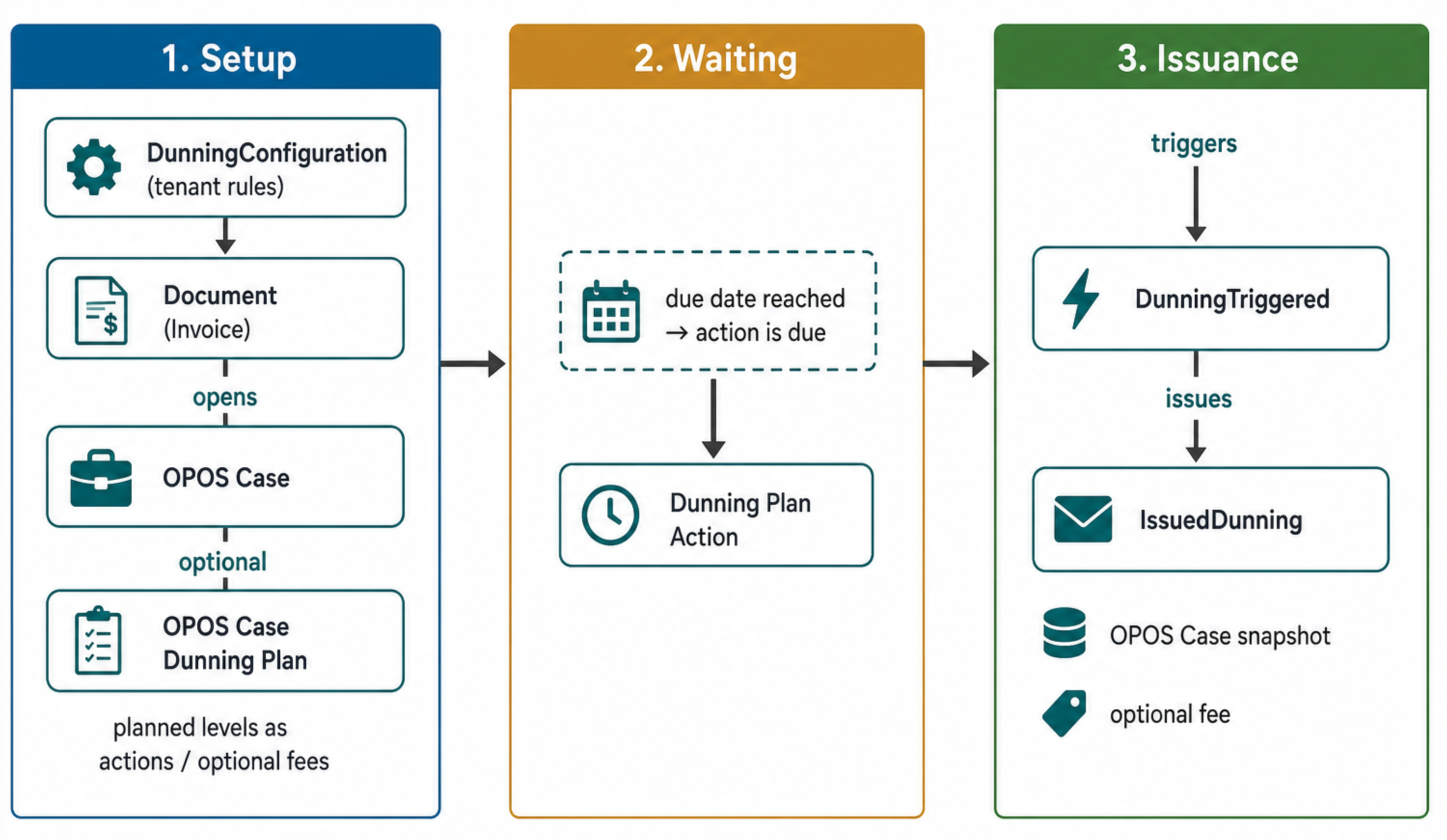
How the Dunning Plan is created
- An invoice (or eligible document) opens an OPOS Case.
- If Enable Dunning Plan Creation is on, instellix selects a configuration: first matching matching rule (based on attributes of the initial invoice).
- A Dunning Plan is stored on the case: planned levels, timing, and optional fees.
- Later changes to tenant configuration do not change existing plans.
- When a plan action’s due date is reached and issuance is not paused / blocked, the action is issued → Issued dunning (snapshot + optional fee on the case).
While a dunning block is active, due actions are not issued; when the block is removed, remaining plan dates are adjusted — see Dunning Block.
When a dunning block is active, planned actions are deferred; when the block is removed, remaining plan dates are adjusted (see Dunning Block).
Fees on the OPOS Case
- Optional fees are planned on the Dunning Plan (per level).
- The fee is booked only when the level is issued (as part of Issued dunning), not when the plan is created.
- The fee is booked on the OPOS Case as an assignment related to issued dunning
- Fee currency must match the case currency; otherwise the fee is skipped.
Document generation for issued dunning depends on PDF Creation and template provisioning for your tenant.
Related articles
Updated about 1 month ago