
Tenants
A tenant is the legal entity that is serviced by our product.
Difference between Client and Tenant
The client is considered the entity that licenses instellix to support the billing operations.
The tenant is the legal entity, for which a license is bought which is managed independently.
A instellix client can have multiple tenants, e.g. a worldwide operating company with multiple, independent national companies where each company is a separate legal entity. An indication of multiple tenants would be separate general ledgers between the entities.
Depending on the client's business structure, a client can have (and may need) several tenants. Each tenant requires its own instellix license. If a instellix client has more than one tenant, it is referred to as multi-tenancy.
Multi-Tenancy Example
The Digital Car Company AG has two subunits: the "Charging GmbH" and the "Platform GmbH". Both are independent companies and monetize their respective business models with instellix.
Both companies have to be operated as separate tenants in the instellix Platform, thus two instellix licenses are necessary.
The scenario looks as follows:
Client: Digital Car Company AG (contractual relationship with instellix)
Tenant 1: Charging GmbH (separate technical unit in the instellix Platform), 1 license necessary
Tenant 2: Platform GmbH (separate technical unit in the instellix Platform), 1 license necessary
Total: 2 instellix licenses owned by Digital Car Company AG
Each tenant has access to the instellix Webportal, its users, business models, etc - all data is completely separated between tenants and will be reported on separately.
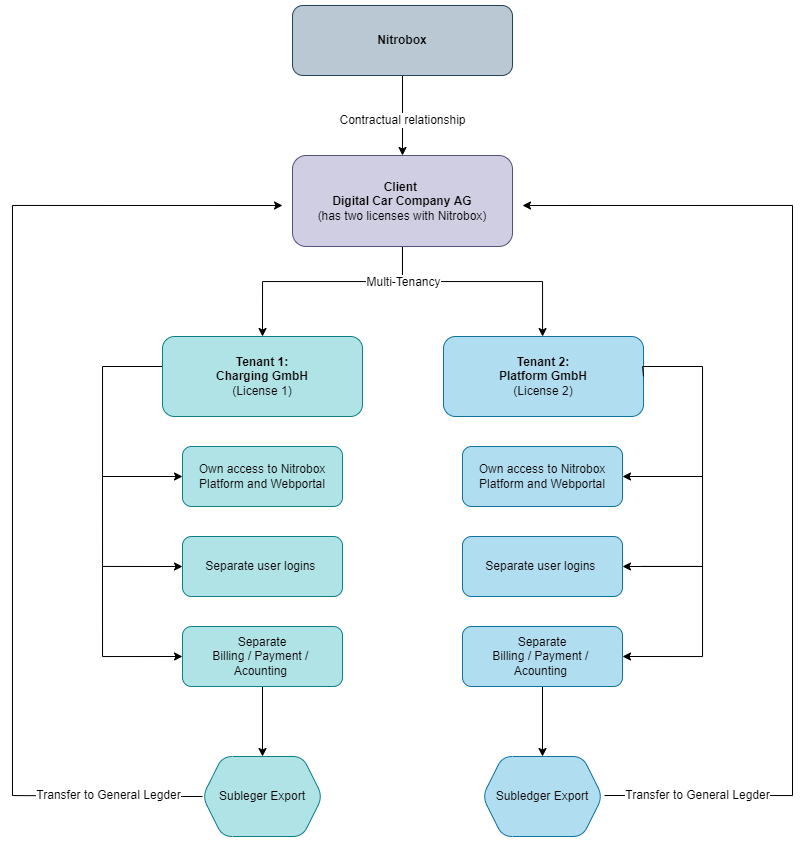
Multi-Tenancy in the instellix Platform
Single-Tenancy
Note: However, if the subunits are not separate legal entities but the same company, a single tenant is sufficient. Using billing groups and business segments, a single tenant can be structured in a way that reflects complex billing requirements within a single tenant.
Tenant Configuration
The following features can be configured and used on a tenant-level
- Management of Billing Groups
- Operating Sites
- Options and Products
- Document Configuration
- Document Aggregations
- Document Number
- Translation Management
- Document Template
- Document Archiving
- Dunning
- Taxation
- Payment
- Payment Categorization Rules
- Payment Assignment Rules
- Payment Providers
- Accounting
- Chart of Accounts
- Booking Rules
- Currency Exchange Rates
- Revenue Recognition
- Notifications & Webhooks
- Integrations
- E-Invoicing
- Output management
- Manage Users
- API Keys
Updated about 1 month ago